CONSOLIDATED VERSION OF THE TREATY ON EUROPEAN UNION
ARTICLE 2
The Union is founded on the values of respect for human dignity, freedom, democracy, equality, the rule of law and respect for human rights, including the rights of persons belonging to minorities. These values are common to the Member States in a society in which pluralism, non-discrimination, tolerance, justice, solidarity and equality between women and men prevail.
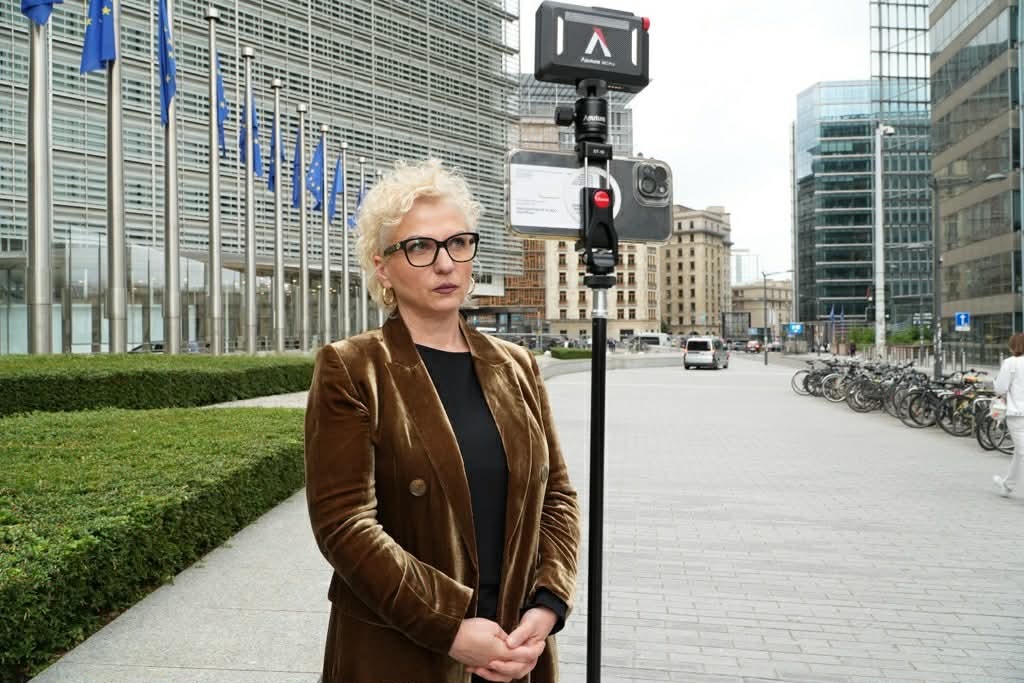
At a time when European values such as respect for human dignity, democracy and freedom of expression are more important than ever, journalism is not only a profession but also a mission. Gjeraqina Tuhina lives this every day. Europe House in Kosovo has chosen to highlight her story, showing how one journalist’s work connects citizens with the values that Europe represents.
Gjeraqina Tuhina begins her story with a sentence that captures her roots: “I was born in Pristina, I am a Pristina girl.” Even though she has lived in Brussels covering EU affairs for more than two decades, her connection to the city where she grew up remains strong.
She grew up in the difficult conditions of 1990s Kosovo, which left their mark. She began studying at the Faculty of Law, inspired by her father, before finding her way into journalism. “I fell in love with journalism,” she says, after getting close to the editorial team of Koha magazine and attending a course organised by Veton Surroi.
For her, journalism is more than a job. “Journalism is not a profession, it is love... if you are in it, you are in it with all your heart.” She proved it early on, reporting from the field during some of the most difficult events in Kosovo’s recent history, before her career turned towards Europe.
In the spring of 2000, she moved to Brussels to work at Radio Free Europe/Radio Liberty, and ten years later, she also became a Senior Correspondent for RTK. “My idea was to stay six months or a year and return to Kosovo,” she recalls. What started as a temporary assignment turned into a long chapter of her life and career, which now helps inform the Kosovo public about the EU.
The transition was stark. From the fast-paced, high-risk journalism she knew, she found herself in an orderly environment, where everything unfolded through official documents, press conferences, and official procedures. “It took me time to learn the terminology, to understand the differences between institutions, and especially to understand what is said between the lines,” Tuhina recalls. The first year was the most difficult, but gradually she managed to integrate and understand how media and diplomacy function in a European context.
Working in Brussels also gave her something she could not have gained from a distance: direct access to European decision-makers. Figures she once only saw on screen became people she could question directly about decisions affecting the region. “This has helped me better understand the ‘big picture,’” she says, explaining that EU decision-making is often not linear and requires engagement of all the EU Member States.
Being a woman from Kosovo, she says, has been both a challenge and a strength. Coming from a country with a recent and complex history, she notices things in the EU corridors that others might miss, particularly when it comes to justice and transition. Her knowledge of languages and the regional context has, in fact, given her an edge in her reporting.
Journalists from Kosovo and the region, she believes, bring something different to European reporting: they have lived through transition and state-building, and that shows in how they tell stories. As a woman in the field, she sees progress but also knows the barriers have not disappeared. “Women are more present and more visible, but barriers still exist, often in more subtle forms,” she says.
But perhaps nothing captures Tuhina quite like 22 March 2016. She was on her way to the hospital to give birth to her son when she heard that terrorist attacks had occurred in Brussels. Even then, her professional instinct kicked in. She asked the doctors if the delivery could wait. Dressed in a hospital gown, she connected live by phone with Radio Television of Kosovo (RTK) for a special broadcast. “We did it live over the phone,” she says. The delivery, planned for 10 a.m., was postponed until noon.
“It is a calling... something sacred.”
Even after more than two decades, she continues to see her work as a life mission. When asked whether the journey in journalism had been worth it, she answers with conviction:
“Yes, it was worth it.”